Search for 'Coir Brushes'


4 mins
2024-09-12
0
0
Copy Link
If you are reading this, chances are you already know about climate change. Do you want to live more sustainably but don’t know where to start? You are not alone. As you can see in the snapshot below, google searches for the words ‘sustainable’, ‘eco-friendly’, ‘second hand’, and ‘plastic-free’ have gradually increased over the last decade. On the other hand, the number of searches for the word ‘cheapest’ has fallen sharply since 2010. A clear trend seems to emerge - people are more conscious about their buying habits and want to do what’s right for the planet. Today, we will talk about how you can kick off your sustainability journey, your ‘Ecoyaan’!
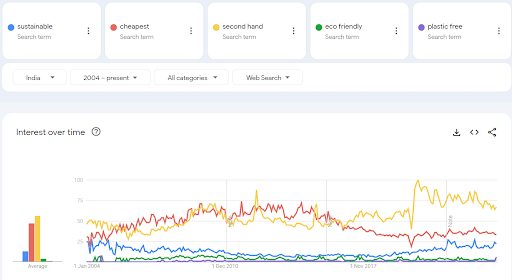
Comparing the number of Google searches for sustainable, cheap, and eco-friendly over time (India only)
The first step in any endeavour is to understand the problem. If you haven’t spent much time learning about the main causes of climate change, start with a trusted source like the UN or an NGO like Project Drawdown. For movie lovers, there are some really good documentaries on this matter, like ‘An Inconvenient Truth’ or ‘Before the Flood’. YouTube channels like Vox , DW-PlanetA , ‘ The Better India ’ , and ‘ Down to Earth ’ are also great for keeping up with the latest news on this topic. You can also follow our instagram page or our climate blog to learn about environmental problems and solutions. One of the most important things to understand the various sources of greenhouse gases. Spend a few minutes looking at the following pie chart.
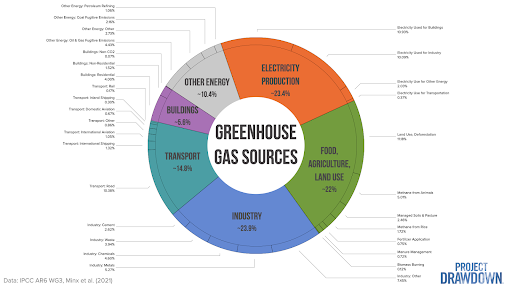
Source: Project Drawdown article
Now, try to figure out where the majority of your carbon emissions come from. For example, even though aviation is a small portion of the total global emissions (~2.5%), it makes up 99% of Elon Musk’s emissions. Taking one long-distance flight can undo or undermine months of effort in reducing waste, plastic, etc. Alternatively, eating red meat or blasting the AC at 16C may be increasing your carbon footprint. So, there is no one-size-fits-all when it comes to climate action - each of us has to be more aware of our own footprint and then try to address that gradually.
Let’s say you are planning a trip. The first thing you need to do is figure out the right destination for your family. Do I want to go to the beach or the mountains? Do I want to party or relax? Do I want to travel by car, train or air? Similarly, sustainable living also requires meticulous planning.
-
Calculate your carbon footprint by using an estimator like this one
-
I want to reduce my carbon footprint by 10%, 20%, 30%, 40%, etc.
-
I want to reduce my footprint to be under the recommended goal of 2.3 tonnes per capita, per year.
-
I want to live like a monk and minimise my impact on the environment.
Planning questions (not an exhaustive list):
Can I install solar panels on my roof? If not, why not? Can I convince the homeowners association?
Do I need a 2-wheeler or a 4-wheeler? Do I have EV charging capability at home?
Can I buy more organic food? Can I buy from small-holder organic farmers directly instead of supermarkets?
Can I reduce my AC/heating costs at home? Can I install fans, water coolers, or 5-star energy-rated ACs? Can I be comfortable at a slightly higher temperature setting on my AC?
What is the ideal home size for my family? Smaller is better for the planet.
If I reduce dairy products, what alternatives are out there? Like Soy paneer, non-dairy milks.
Can I take a Volvo bus or train for my next holiday, instead of flying?
Can I plan a trip to Lakshadweep or Maldives, instead of Bali? It could cut my trip’s emissions drastically.
Can I start composting food scraps at home?
What products can I cut out from my daily life? Most people have more jewellery, electronics, toys, and clothes than they need.
Are there any second-hand or thrift stores near me that sell used clothes?
Where can I buy sustainably sourced goods? Are these stores vetted by professionals or are they simply greenwashing?
Hooray. You are ready to go on your vacation. But right when you are about to leave, your car has a flat tire. Will you cancel your trip because of this one hurdle? No. You will figure out the quickest solution, even if it is expensive. Maybe you are forced to call a taxi and are stuck with a grumpy driver for your journey. Things may not be perfect, but you are still on the way to a gorgeous place with your favourite people in the world. Again, climate action journeys are very similar. You will inevitably face hurdles along the way. If you have also spent hours searching for the most eco-friendly trash bag, or plastic-free straws, but have given up after spending an hour on Amazon, it shows that you care. You are on the right track. With a little guidance and awareness, you can also create a resolute climate action plan. Remember the following guidelines when you reach this step:
Progress is more important than perfection: For example, if you can’t live without a car, you can still buy the most fuel-efficient car and reduce driving distances. If you can't live without an AC, you can at least reduce your energy footprint by keeping the thermostat @25C. Every step matters, however small. You don't have to give up red meat entirely; cutting down beef and mutton consumption to once a month instead of once a week may be sufficient to save the planet. We all don't have to stop doing things we love, we just need to do them less often and with less intensity.
Putting community over self: For example, buying a new toy for your child may bring temporary joy to them but the industrial emissions of producing it will likely end up hurting all kids in your community, city, country, and world. If you make decisions with your society’s best interests in mind, it will usually be a more sustainable choice.
Motivation must be resolute: For example, securing a safe and happy future for a child is a strong motivator for most people. For others, it may be love for nature or love for animals. If you are forced to take the longer route to the cafe because there is a zero-waste store along the way, maybe the detour is worth it because your motivations are so strong.
Prioritise actions: Doing everything at the same time can get overwhelming, and you will be prone to mental or physical burnout. As discussed earlier, knowing where your emissions come from can help focus your efforts in the right direction. For example, plastic is undoubtedly bad for the environment, but most of us spend a disproportionate amount of time thinking about that one problem. Freeing up some mind space so that you can tackle the larger sources of emissions (food, energy, transportation) can provide clarity and eventually, better results.
A recent poll of 130,000 people across 125 countries showed that people are willing to do more to tackle climate change than they predicted. 60% of Indians are willing to give 1% of their income towards solving climate change, again, much more than predicted. As Hanah Ritchie of ‘Our World in Data’ explains, “..people tend to be positive about themselves, but negative about other people they don't know”. When we believe others are not doing their part to solve such an existential issue, we get discouraged from doing so ourselves. Many of us question whether our actions have any meaningful impact if the vast majority of the population doesn't care about climate change. It’s important to remember that everyone loves their family and is generally willing to do anything to ensure a safe, happy future for them.So, whenever you get discouraged, remember that you are not alone. Hundreds of millions of Indians are thinking about this and taking steps towards sustainable living.
Earlier this year, The Supreme Court of India, for the first time, recognized the right against the adverse impacts of climate change, saying it is intertwined with the right to life and equality as per the Indian constitution. Our constitution is embarking on a long and arduous journey towards sustainability. Hopefully, this article helps you do the same. Learn, plan, implement, and believe in the collective will of our society. There is no plan(et) B. In future articles, we will discuss sustainable products in different categories like food, cosmetics, clothing, transport, etc. Stay tuned.
7 mins • 2026-06-02

5 mins • 2026-05-20

6 mins • 2026-04-18

6 mins • 2026-03-31

5 mins • 2026-01-23
5 mins • 2026-01-21
0
0
Copy Link
to write a comment.